Note
Click here to download the full example code
Typical usage
To demonstrate the use of the Hankel Transform class, we will give an example of propagating a radially-symmetric beam using the beam propagation method.
In this case, it will be a simple Gaussian beam propagating way from focus and diverging.
First we will use a loop over \(z\) position, and then we will demonstrate
the vectorisation of the HankelTransforms.iqdht() (and
qdht()) functions.
First import the standard libraries
import matplotlib.pyplot as plt
import numpy as np
Then the functions from this package
from pyhank import HankelTransform
# noinspection PyUnresolvedReferences
from helper import gauss1d, imagesc
Initialise radius grid
Initialise \(z\) grid
Set up beam parameters
Set up a HankelTransform object, telling it the order (0) and
the radial grid.
H = HankelTransform(order=0, radial_grid=r)
Set up the electric field profile at \(z = 0\), and resample onto the correct radial grid
(transformer.r) as required for the QDHT.
Propagate the beam - loop
Do the propagation in a loop over \(z\)
# Pre-allocate an array for field as a function of r and z
Erz = np.zeros((nr, Nz), dtype=complex)
kz = np.sqrt(k0 ** 2 - H.kr ** 2)
for i, z_loop in enumerate(z):
    phi_z = kz * z_loop  # Propagation phase
    EkrHz = EkrH * np.exp(1j * phi_z)  # Apply propagation
    ErHz = H.iqdht(EkrHz)  # iQDHT
    Erz[:, i] = H.to_original_r(ErHz)  # Interpolate output
Irz = np.abs(Erz) ** 2
Plotting
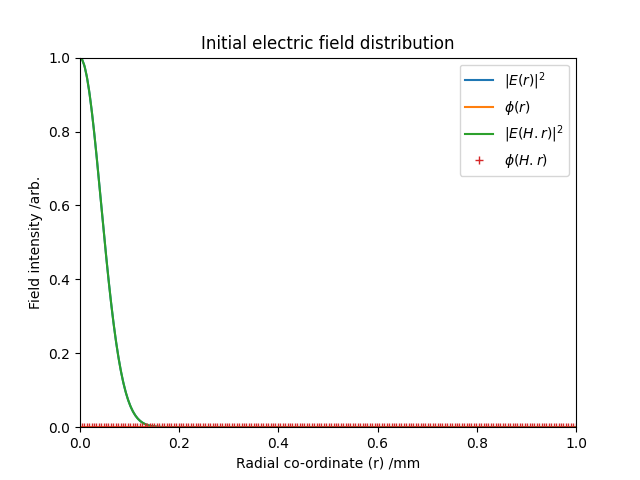
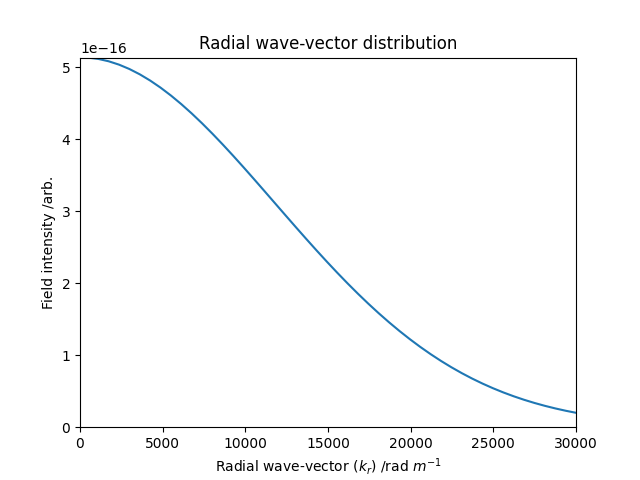
Plot the initial field and radial wavevector distribution (given by the Hankel transform)
plt.figure()
plt.plot(r * 1e3, np.abs(Er) ** 2, r * 1e3, np.unwrap(np.angle(Er)),
         H.r * 1e3, np.abs(ErH) ** 2, H.r * 1e3, np.unwrap(np.angle(ErH)), '+')
plt.title('Initial electric field distribution')
plt.xlabel('Radial co-ordinate (r) /mm')
plt.ylabel('Field intensity /arb.')
plt.legend(['$|E(r)|^2$', '$\\phi(r)$', '$|E(H.r)|^2$', '$\\phi(H.r)$'])
plt.axis([0, 1, 0, 1])

plt.figure()
plt.plot(H.kr, np.abs(EkrH) ** 2)
plt.title('Radial wave-vector distribution')
plt.xlabel(r'Radial wave-vector ($k_r$) /rad $m^{-1}$')
plt.ylabel('Field intensity /arb.')
plt.axis([0, 3e4, 0, np.max(np.abs(EkrH) ** 2)])
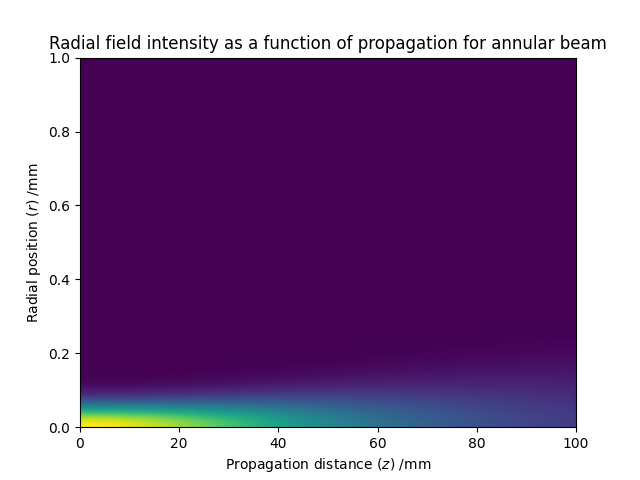
Now plot an image showing the intensity as a function of radius and propagation distance.
plt.figure()
imagesc(z * 1e3, r * 1e3, Irz)
plt.title('Radial field intensity as a function of propagation for annular beam')
plt.xlabel('Propagation distance ($z$) /mm')
plt.ylabel('Radial position ($r$) /mm')
plt.ylim([0, 1])
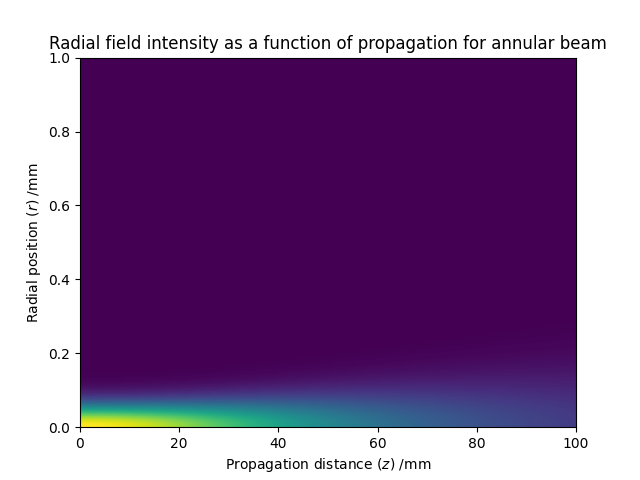
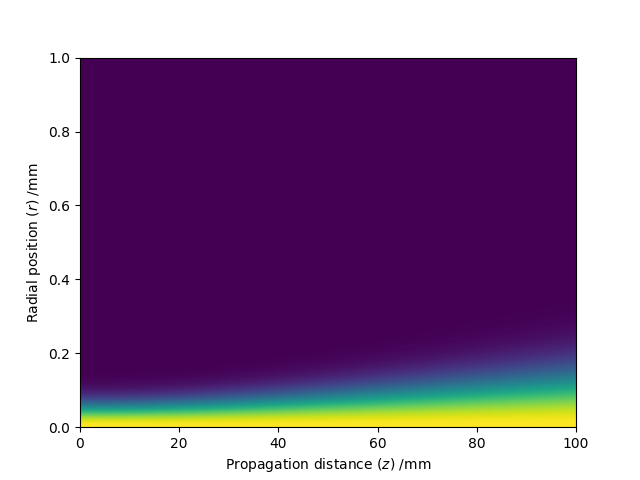
The plot above shows a reduction of intensity with \(z\), but it is bit difficult to see the beam growing in \(r\). To show that, let’s plot the intensity normalised such that the peak intensity at each \(z\) coordinate is the same.
Irz_norm = Irz / Irz[0, :]

plt.figure()
imagesc(z * 1e3, r * 1e3, Irz_norm)
plt.xlabel('Propagation distance ($z$) /mm')
plt.ylabel('Radial position ($r$) /mm')
plt.ylim([0, 1])
Propagate the beam - vectorised
Now plot the result to check it is the same as the loop approach
plt.figure()
imagesc(z * 1e3, r * 1e3, Irz_vectorised)
plt.title('Radial field intensity as a function of propagation for annular beam')
plt.xlabel('Propagation distance ($z$) /mm')
plt.ylabel('Radial position ($r$) /mm')
plt.ylim([0, 1])
Assert the two approaches produce the same intensity
assert np.allclose(Irz, Irz_vectorised)
Total running time of the script: ( 0 minutes 2.326 seconds)